Absolute Asia/Destinations/South Korea/Places to Visit/Dali
Private & Tailor-Made South Korea Tours
Private Journeys in Dali
The Essence of Dali
Accommodation choices for Dali We’ve selected a range of accommodation options for when you visit Dali.
Dali sits on a plain between the Cangshan mountains and Erhai Lake in western Yunnan, and it was the center of two kingdoms, Nanzhao and Dali, for about five hundred years. Today it is the capital of the Dali Bai Autonomous Prefecture, where the Bai people make up about 32% of residents and Han Chinese about half. Visitors come for the walled old town, the Three Pagodas, the lake and the slow pace.
| Prefecture | 28,302 km²; average elevation 2,090 m; about 3.34 million residents; Bai about 32% |
|---|---|
| Old kingdoms | Nanzhao founded 738 by Piluoge; the Dali Kingdom from 937 until the Mongol conquest |
| Dali Old Town | Ming-era walled town begun after 1381; wall once 7,248 m around; national historic city since 1982 |
| Three Pagodas | Chongsheng Temple; national protected site since 1961; 5A-rated area |
| Erhai Lake | about 250 km²; up to about 21 m deep; about 42.6 km long and 9 km wide |
The old town
The present old town was built by the Ming after their army took Yunnan in 1381, east of the earlier royal city of Yangjumie, which had served the Nanzhao and Dali kingdoms for nearly five centuries. The Ming wall ran about 7.2 kilometers with four gates and corner towers. Only about 300 meters of it remains, and the south and north gates were rebuilt in 1984, the west gate in 2001 and the east gate in 2002. The main north–south road, Fuxing Road, runs between the gates and passes the Dali Municipal Museum, which occupies the former headquarters of the rebel leader Du Wenxiu, the Wuhua Tower and the Confucian temple. Foreigner Street in the northwest is the busiest tourist strip. For quieter walks, try the side lanes.
The Three Pagodas of Chongsheng Temple
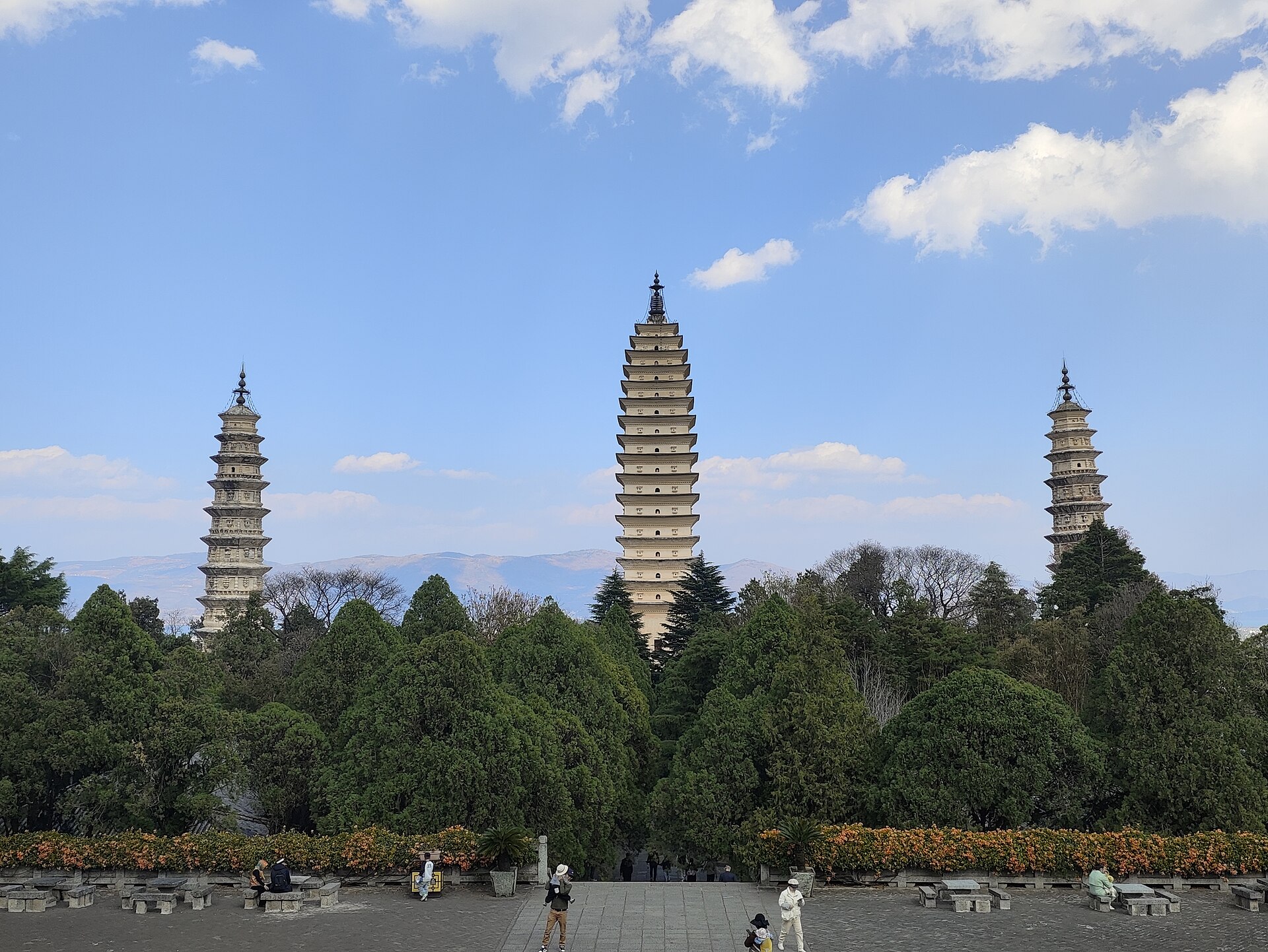
The Three Pagodas stand northwest of the old town below the Cangshan peaks. The tallest, the Qianxun Pagoda, is flanked by two smaller towers set in a triangle. Sources disagree on when the main pagoda was built; dates of 633, 714 and 836 are all proposed, but an inscription dated 889 was found in the pagoda wall in 1984. The pagodas were damaged by earthquakes, repaired in 1550 to 1553, lost the top of the main pagoda in a quake in 1925, and were fully restored from 1978 to 1981. The temple itself no longer exists. They became a national protected site in 1961.
Erhai Lake
Erhai is Yunnan’s second-largest freshwater lake and one of the largest in China. Chinese Wikipedia gives it a surface of about 250 square kilometers, a maximum depth of about 21 meters and a length of 42.6 kilometers from north to south, with 117 streams feeding it, 18 of them from the Cangshan mountains. The waves are small and the shore is flat, which makes it good for cycling the lakeside. Its only outlet is the Xi’er River near Xiaguan.
How long to stay
Dali pairs well with Lijiang and Kunming; most itineraries give it one or two nights. Spend one day on the old town and the Three Pagodas, and another on the lake and Xizhou. At about 2,000 meters elevation, nights can be cool even in spring.
Planning Dali with Absolute Asia Tours
Absolute Asia Tours has planned private trips in Asia since 1989. For Dali that means a guest house in the old town or by the lake, a driver for the lakeside villages and a guide who can explain Bai culture. We’re rated 4.8 out of 5 across about 900 traveler reviews. See our China tours or tell us your dates.
Sources (read in Chinese, Chinese Wikipedia): 大理白族自治州, 崇圣寺三塔, 洱海, 大理古城. Last checked November 2026.
Dali: FAQ
What is Dali known for?
A Ming-era walled old town, the Three Pagodas, Erhai Lake and the Bai culture, on the site of the old Nanzhao and Dali kingdoms.
How big is Erhai Lake?
About 250 square kilometers, up to about 21 meters deep and 42.6 kilometers long.
When were the Three Pagodas built?
Sources disagree. Dates of 633, 714 and 836 are proposed for the main pagoda, and an inscription from 889 was found in it in 1984.
How many days do you need in Dali?
One or two nights is usual, with a day for the old town and pagodas and another for the lake.
Who are the Bai people?
An ethnic group that makes up about 32% of the prefecture’s population.
Photo: Ngguls, Wikimedia Commons, CC BY-SA 4.0. The Three Pagodas of Chongsheng Temple.

The Private Difference
Tailor-Made Dali Journeys
Absolute Asia crafts completely tailor-made, 100% private luxury journeys across South Korea. Guided by certified English-speaking scholar specialists, experience private after-hours access to Changdeokgung's Secret Garden, private hanbok fittings in Bukchon, high-speed KTX First Class rail to the ancient Silla capital of Gyeongju and coastal Busan, and stays at premier properties including Four Seasons Hotel Seoul and Signiel Busan.
Destination Quick Facts
| Ideal Duration | 7 – 12 Days (or 14 – 18 Days combined with Japan) |
| Best Season | Apr – May (Cherry Blossom Season & Mild Spring), Sep – Nov (Crisp Skies & Spectacular Autumn Foliage) |
| Typical Budget | $550 – $1,200+ per guest / day (Private executive vehicle & chauffeur, KTX First Class, certified bilingual guide, 5-star luxury hotels & domestic flights) |
| Travel Style | 100% Private, Tailor-Made Cultural Immersion & Contemporary Luxury |
| Best For | UNESCO Royal Palaces & Hanok Villages, Haute Korean Gastronomy & Michelin Dining, High-Speed KTX Rail, Contemporary Art & Architecture, Coastal Temples & Volcanic Jeju |
Our Favorite Journeys
Suggested itineraries featuring Dali
Our itineraries will give you suggestions for what is possible when you travel in Dali, and they showcase routes we know work particularly well. Treat them as inspiration, because your trip will be created uniquely by one of our specialists.
We are composing new Dali itineraries right now. Tell us what you have in mind and a designer will build one around you.
Transparent Pricing Intelligence
What Does a Private Dali Tour Cost?
South Korea combines ultra-modern infrastructure with deep dynastic traditions. Every Absolute Asia journey includes dedicated private executive vehicles and chauffeurs, KTX First Class bullet-train seating with luggage forwarding, licensed bilingual cultural guides, curated royal dining, and vetted 5-star luxury accommodations.
$550 – $750 per guest / day
Premier 5-star international hotels (The Shilla Seoul, Grand Josun Busan), private chauffeured touring, KTX First Class bullet-train tickets, licensed English-speaking guide, and curated palace admissions.
- 5-star luxury city and beach hotels
- Dedicated private executive sedan or minivan and chauffeur
- Licensed bilingual cultural guide throughout touring days
- Reserved KTX First Class bullet-train tickets between cities
- All curated palace admissions, hanbok experience & tea tastings
$800 – $1,350 per guest / day
World-class properties (Four Seasons Hotel Seoul, Signiel Busan) combined with authentic luxury hanok suites (Rakkojae Bukchon), private royal court dinner prepared by an intangible cultural heritage chef, and private DMZ tour.
- Luxury suites at Four Seasons Seoul and Signiel Busan
- Exclusive private hanok stay with cypress baths and traditional ondol heating
- Private VIP Korean culinary masterclass with a master chef
- Private chauffeured touring of the DMZ with exclusive access permissions
- 24/7 dedicated bilingual travel concierge & airport fast-track
$1,450 – $2,600+ per guest / day
The pinnacle of Korean luxury: Presidential suites, JW Marriott Jeju Resort & Spa clifftop villas, private helicopter volcano tours, after-hours private viewing of UNESCO royal tombs, and Michelin 3-star culinary dining.
- Top-tier executive suites and clifftop private villas in Jeju
- Private helicopter transfers and coastal aerial touring
- Private opening of National Treasure temple halls with resident Buddhist monks
- Private yacht charters on Haeundae Bay in Busan
- Unrestricted bespoke dining reservations and private sommelier pairings
What Drives Your Total Investment?
- Peak spring sakura (early April) and autumn foliage (October–November) hotel demand
- Boutique luxury hanok residences have very few rooms (3–5 suites per property)
- Dedicated private executive Mercedes van vs KTX high-speed rail combinations
- Flight hops to Jeju Island (Gimpo to Jeju GMP ⇄ CJU) during holiday periods
Local Operational Realities
What You Need to Know Before Traveling in Dali
KTX High-Speed Bullet Rail & Door-to-Door Luggage Courier
South Korea's KTX bullet train network connects Seoul to Gyeongju in 2 hours and Busan in 2.5 hours at speeds exceeding 300 km/h. To ensure seamless comfort, Absolute Asia coordinates luggage forwarding between city hotels so you board KTX First Class with only daypacks.
Hanok Heritage Living vs. Modern 5-Star Luxury
Traditional Korean hanok homes feature low furniture, paper screen doors, and ondol (underfloor heating). While deeply atmospheric, staying exclusively in hanoks for a whole week can feel rustic. Absolute Asia recommends pairing 1–2 nights in a restored luxury hanok (like Rakkojae) with modern 5-star sanctuaries (Four Seasons Seoul).
Seoul Urban District Pacing & Chauffeur Logistics
Seoul is a massive metropolis divided by the Han River. Transit between northern historical districts (Jongno, Bukchon, Insa-dong) and southern modern hubs (Gangnam, Apgujeong) can be slow during peak traffic. Absolute Asia sequences touring by geographic clusters, maximizing time spent exploring rather than sitting in traffic.
Dining Customs & Dietary Accommodations
Traditional Korean meals emphasize shared banchan dishes, barbecued meats, and broths prepared with garlic, fermented paste, and anchovy stock. Our private concierges coordinate dietary restrictions with chefs in advance to accommodate vegetarian, gluten-free, or pescatarian preferences without sacrificing authentic flavors.
Handpicked 5-Star Sanctuaries
Signature Stays & Exclusive Experiences in Dali
Four Seasons Hotel Seoul
Contemporary Korean luxury overlooking Gyeongbokgung Palace, featuring an authentic Korean bathhouse, Michelin dining, and the Charles H. speakeasy.
Signiel Seoul
Perched between floors 76 and 101 of the landmark tower, offering panoramic skyline vistas over Seoul and the Han River, with Michelin-starred dining.
Signiel Busan
Luxury oceanfront suites in the LCT Tower overlooking Haeundae Beach, featuring outdoor infinity pools, private cabanas, and retreat spa sanctuaries.
Rakkojae Seoul Bukchon
A 130-year-old aristocratic hanok residence restored by a human national treasure, featuring traditional wooden architecture, mud saunas, and private tea pavilions.
JW Marriott Jeju Resort & Spa
Bill Bensley-designed clifftop sanctuary blending Jeju volcanic stone with modern luxury, overlooking the dramatic southern coast and Olle trails.
The Shilla Seoul
Distinguished Korean grande dame featuring traditional sculpture gardens, the 3-Michelin-star Korean restaurant La Yeon, and Urban Island pool cabanas.
Tailored to Your Style
Family & Honeymoon Journeys in Dali
Private South Korea Family Adventures
An exciting, high-energy journey for families: explore Gyeongbokgung Palace dressed in bespoke royal hanbok, learn choreographed dance moves in a private K-pop studio, ride 300 km/h KTX bullet trains to Busan, walk across the glass sky bridge 500 meters up Lotte World Tower, and explore ancient royal burial mounds in Gyeongju.
- Private hanbok fitting and photographer-escorted exploration of royal Joseon palaces
- Interactive K-pop dance and vocal masterclass with professional entertainment trainers
- High-speed KTX First Class bullet-train rides across the Korean peninsula
- Private hands-on kimchi making and Korean barbecue culinary masterclasses
- Family-friendly coastal yacht cruises and beach fun along Busan's Haeundae shoreline
Romantic Korea & Jeju Island Escapes
An intimate, sophisticated romantic getaway: stay in a private luxury hanok with traditional cypress hot tubs, take part in an exclusive tea ceremony in Bukchon, enjoy private sunset champagne cruises along Busan's illuminated Diamond Bridge, and retreat to a secluded private pool villa on volcanic Jeju Island.
- Exclusive private hanok suite stays with traditional ondol comfort and wooden courtyards
- Couples' Korean traditional spa rituals featuring red ginseng, jade stone, and hydrotherapy
- Private candlelit dinners at Michelin-starred Korean contemporary dining rooms
- Private sunset yacht charters on Haeundae Bay with champagne and coastal vistas
- 24/7 dedicated private chauffeur and concierge managing all reservations and VIP entries
Cross-Border Extensions
Seamless Multi-Country Extensions Beyond Dali
Connect multiple Asian cultures into one coherent private journey with expert in-country concierge coordination.
Japan & South Korea: East Asia Cultural Icons
Tokyo → Hakone → Kyoto → Osaka → Seoul → Busan
Short 2-hour non-stop flight connecting Osaka Kansai (KIX) or Tokyo Haneda (HND) to Seoul Incheon (ICN) / Gimpo (GMP).
When to Go
The premier seasons to visit South Korea are spring (April to May) for the cherry blossoms and pleasant spring warmth, and autumn (September to November) for crisp blue skies, low rainfall, and breathtaking autumn colors across national parks and palaces.
Winter (December to February) is crisp and snowy, ideal for hot stews, Korean saunas (jjimjilbang), and quiet palace strolls.
Month by Month
South Korea Through the Seasons
Cherry Blossom Spring (Beotkkot)
Delicate pink blossoms across Yeouido and Gyeongju; pleasant mild weather perfect for palace gardens and outdoor walks.
Summer Energy & Coastal Busan
Lush green mountains, vibrant summer beach festivals in Busan, and refreshing coastal breezes on Jeju Island.
Crisp Autumn Foliage (Danpung)
Spectacular crimson maples and golden gingko trees across Seoul palaces, Gyeongju tumuli, and Mount Seorak.
Winter Dynasties & Warm Saunas
Crisp winter skies, snow-covered royal roofs, steaming Korean bathhouse rituals, and quiet cultural touring.
Frequently Asked Questions
Private Travel to Dali: Essential Advice
Verified Traveler Stories
Recent Guest Experiences in Dali
“Our private tour through Seoul, Gyeongju, and Busan with Absolute Asia was flawless. Our guide, Min-jun, brought Korean royal history to life at Gyeongbokgung and took us to private artisan studios in Bukchon that we never would have discovered alone. Four Seasons Seoul and Signiel Busan were both magnificent.”
“Combining the high-speed KTX train with luggage forwarding was a masterstroke—we traveled so easily between Seoul and Busan. The private street food tour in Gwangjang Market and our stay at Rakkojae hanok were the highlights of our East Asia trip.”

Start Planning
Ready to see Dali on your own terms?
Share a few details and a private travel designer will reach out within one business day.